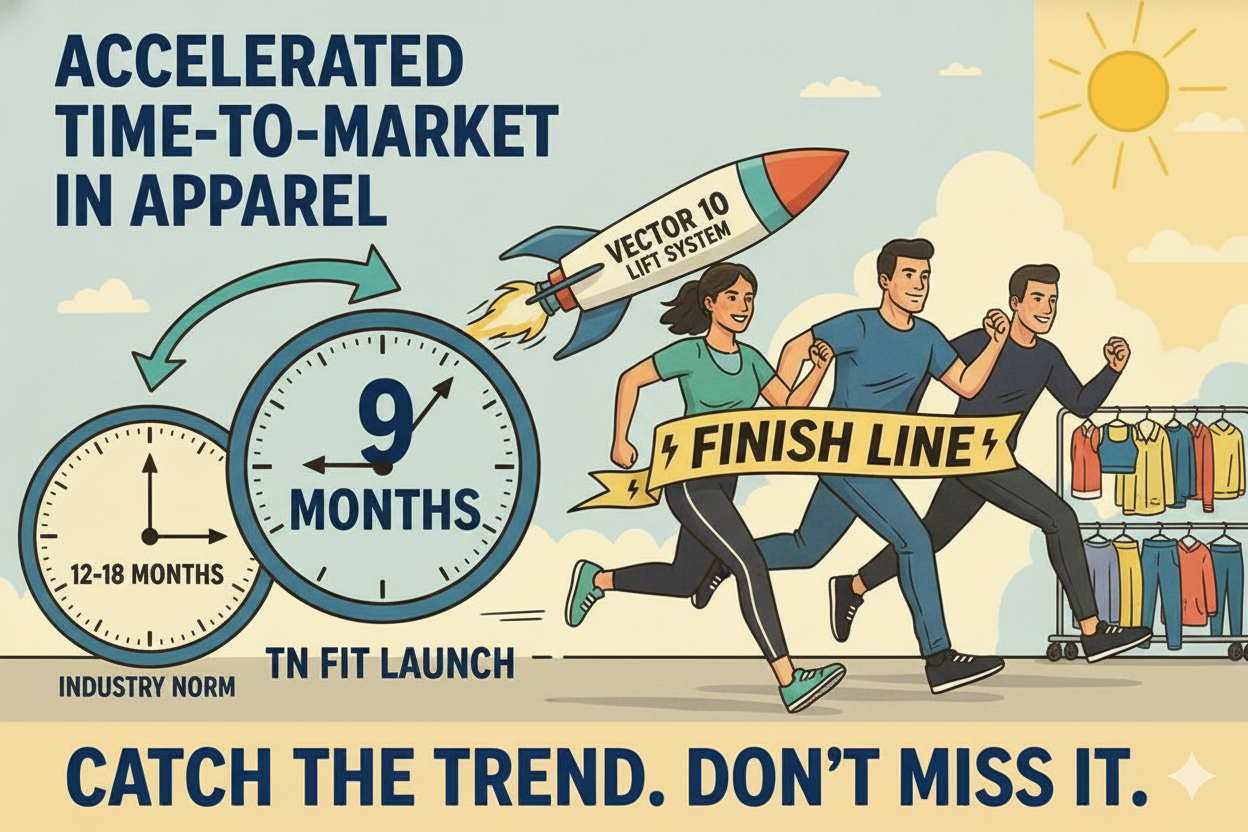
For many brands, accelerated time-to-market in apparel can make the difference between catching a trend or missing it entirely. The window between cultural moment and commercial opportunity is measured in months, not years — and traditional development timelines rarely respect that urgency. Tonia Nicole, an established luxury brand with deep roots in premium women's fashion, understood this precisely when it decided to expand into activewear. The result was TN Fit: a private-label activewear line targeting style-conscious women ages 35–55, built not just to compete but to connect — to reflect the lives and sensibilities of women who refuse to choose between performance and presence.
What the brand needed was a partner who understood that speed without integrity produces nothing worth selling. What it found was Vector 10's LIFT platform — and proof that these two imperatives can coexist.
Background: What TN Fit Set Out to Be
TN Fit was conceived as an everyday activewear line with a deceptively simple mandate: work for every day, for any day. Leggings, athleisure tops, hoodies — the activewear basics that women reach for without thinking, executed with the material intelligence and structural attention you'd expect from a luxury house. The product brief called for premium materials, flattering 3D tailoring, and a fit philosophy anchored not in aspirational sizing but in genuine wearability across a range of body types and movement contexts.
The brand's promise ran deeper than comfort. TN Fit was designed as a vehicle for confident expression — the idea that what a woman puts on first in the morning should support the version of herself she wants to meet the day as. That kind of brand intention demands a product that performs at the level the marketing implies. You cannot claim confidence while delivering a garment that pills after three washes.
The Challenge: Long Timelines and High MOQs
Traditional apparel development operates on a 12–18 month cycle. That rhythm was built around the mechanics of the industry's dominant players: large textile mills, long material lead times, multinational supply chains with multiple handoff points, and buyers who plan seasons eighteen months ahead. For an emerging private-label brand with neither the leverage nor the intention to lock up inventory in multi-thousand-unit minimums, that timeline is less a guideline than an obstacle.
The minimum order quantity problem compounds the timeline challenge. Large textile mills require high MOQs to justify production runs — quantities that force new brands into an uncomfortable binary: produce excessive inventory and absorb the carrying cost and risk, or sacrifice material quality by routing through smaller workshops that may lack the technical capability to execute premium specifications. Neither option serves a brand for whom quality is the entire proposition.
TN Fit needed something the conventional model doesn't naturally offer: the ability to develop premium product at low-to-medium volumes, iterate rapidly based on real market feedback, and scale up production only when demand justified the investment. In other words, the ability to fail fast through small-scale testing before committing to large-scale production — a philosophy borrowed from technology product development and applied to the physical world of cut-and-sew manufacturing.
The LIFT Solution: Six Integrated Strategies
Vector 10's Low Impact Fast Track system addresses these structural challenges not through a single innovation but through six integrated strategies that compress timelines and reduce MOQ barriers while maintaining the material and manufacturing standards that premium products require.
-
Early Co-Creation and Design Alignment. Rather than receiving a completed design brief and then beginning the translation into producible specifications, Vector 10's manufacturing experts engaged from the concept stage. This collapsed the most time-consuming phase of traditional development: the back-and-forth between designers who optimize for aesthetics and manufacturers who optimize for production. By aligning these perspectives from the first conversation, the TN Fit collection entered sampling with designs that were both trend-forward and factory-viable.
-
Brand DNA Preservation. Abstract brand values — confidence, everyday wearability, flattering construction — were translated into concrete product attributes before a single mill was approached. This meant that innovation choices were made in service of the brand's identity rather than in pursuit of novelty for its own sake. Every material selected, every finishing process specified, had to answer a single question: does this reinforce what TN Fit is trying to be?
-
Trusted Mill Network. Rather than approaching mega-manufacturers accustomed to container-scale orders, Vector 10 engaged its network of mid-sized, technically capable mills built for agility. These are manufacturers who have invested in flexibility — shorter setup times, more granular batch sizes, faster communication — because their business model depends on it. Access to this network is not something a brand can build independently; it takes years of relationship development and technical credibility.
-
Rapid Prototyping and Fail-Fast Iteration. Compressed sampling timelines turned what would traditionally be a multi-month approval cycle into a multi-week test-and-adjust process. Physical samples were evaluated against technical specifications and brand criteria simultaneously, with feedback loops designed to surface problems early and resolve them before they became production commitments. This de-risks innovation — you find out what doesn't work before you've paid to make ten thousand units of it.
-
Integrated Supply Chain Management. The gap between design and delivery is where most timelines collapse. Approvals stall, materials arrive late, schedules drift because no single party owns the entire sequence. LIFT's integrated supply chain management model places coordination responsibility with Vector 10 rather than distributing it across brand, mill, and logistics providers who are each optimizing for their own interests. Communication gaps close. Delays surface early. Schedules hold.
-
Built-In Scalability Planning. The TN Fit development process incorporated future scale-up considerations from day one. Materials and processes were selected not only for their performance at pilot volumes but for their commercial viability at high-volume production. When demand grows — as it did — the transition to industrial-scale manufacturing requires no re-engineering. The groundwork was already laid.
Performance Specifications
Speed is only a competitive advantage if the product arriving at the end of the compressed timeline meets the standards the brand requires. For TN Fit, those standards were unambiguous — this was a premium product entering a crowded activewear market where consumer expectations for technical performance are high and tolerance for quality compromise is low.
The collection's technical specifications reflect that demand:
The elastane percentage range — 20 to 32 percent depending on the garment category — reflects a deliberate material strategy rather than a cost-optimization choice. Higher elastane content in compression-oriented pieces delivers the recovery and shape retention that active women depend on through repeated wear and washing cycles. The virgin nylon substrate, rather than recycled alternatives, was selected to meet the hand-feel and performance requirements of a luxury-adjacent product line, with the understanding that recycled materials would be evaluated for future iterations once performance equivalence could be demonstrated.
Five Key Takeaways for SMEs
The TN Fit launch offers replicable lessons for any small or medium-sized brand navigating the gap between brand ambition and supply chain reality.
- Start with low MOQs and plan for scale. Small initial runs reduce financial risk and generate real market data. Design your material and manufacturing choices for scalability from the start, so that success doesn't require rebuilding your supply chain.
- Invest in premium materials. In a crowded category, material quality is a durable differentiator. Commodity fabrics invite commodity comparisons. The right material choices communicate brand values before the customer reads a single word of copy.
- Leverage expert partners. The relationships, technical knowledge, and mill access that took years to build cannot be replicated quickly. Partnering with organizations that hold these assets compresses the learning curve and opens doors that independent brands cannot easily open.
- Embrace fail-fast iteration. The willingness to test and adjust before scaling is not a sign of uncertainty — it is how sophisticated product development works. The brands that try to get everything right the first time at large scale are the ones who warehouse mistakes.
- Integrate supply chain management end-to-end. Fragmented coordination is the single most common source of timeline overruns and quality failures. Own the full sequence — or partner with someone who will.
"Speed and integrity can coexist. The TN Fit launch proved it — 9 months against an industry standard of 12–18."
What LIFT Enables Beyond This Launch
The TN Fit case study demonstrates the framework in one configuration. The LIFT platform's modular architecture means it is not confined to virgin nylon and standard activewear. The same structural approach — early co-creation, trusted mill networks, compressed sampling, integrated coordination, scale-ready design — applies equally to brands building with recycled polyester and recycled nylon, pursuing non-PFAS durable water repellent finishes, incorporating anti-odor treatments, adding UPF protection, or designing with circular end-of-life considerations embedded from the beginning.
Each of these capability areas represents a layer that can be added to or removed from the framework based on a brand's specific priorities. A brand that needs rapid launch and aggressive sustainability credentials gets both. A brand that needs volume flexibility and technical performance gets that combination instead. The framework adapts to the brief — the brief does not adapt to the framework.
For brands that recognize speed as a strategic asset rather than a compromise, and for those who refuse to accept that quality must be traded against timeline, TN Fit is not just a case study. Explore Vector 10's full range of solutions to see how each engagement begins. It is a proof of concept. The question is which brand moves next.