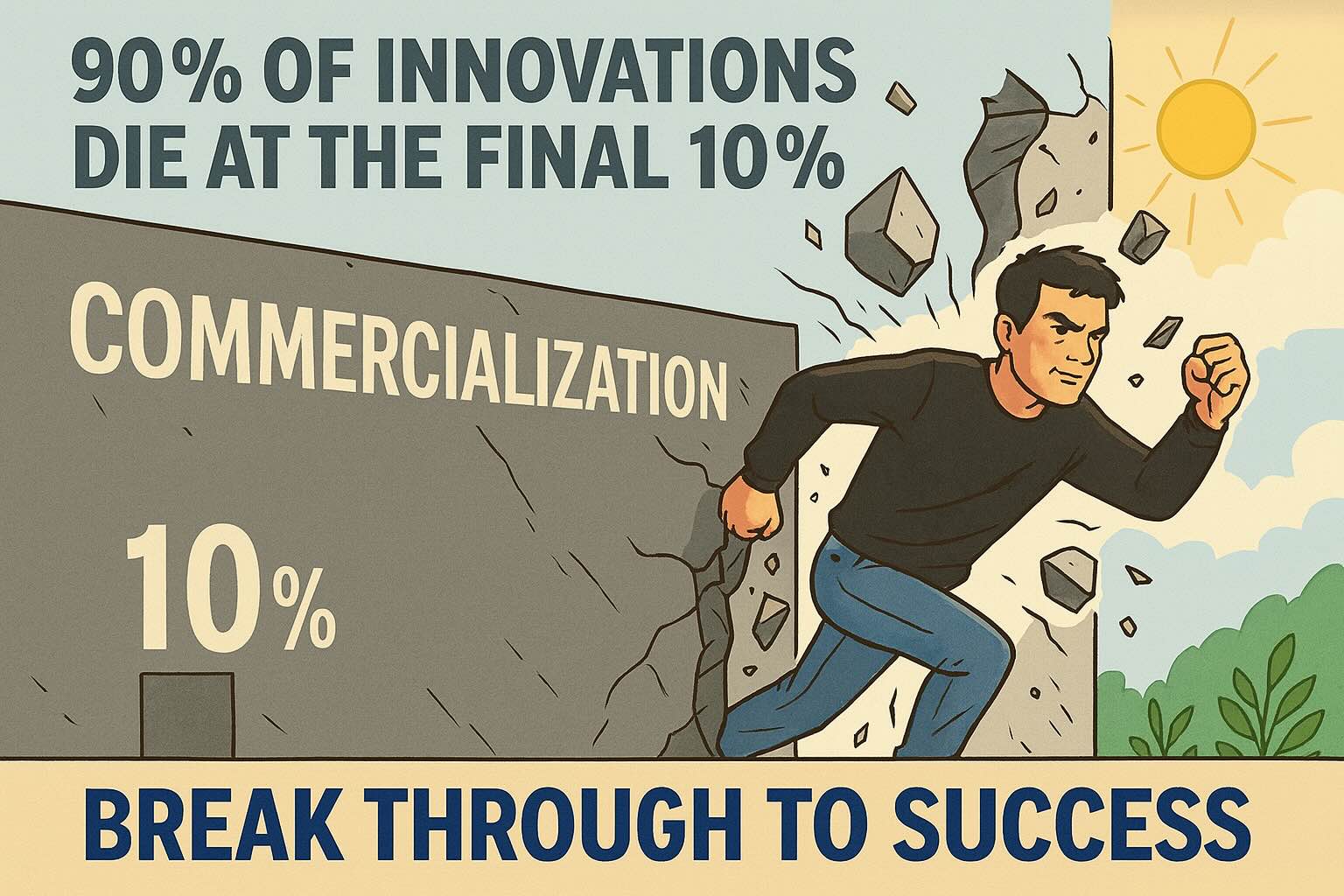
Innovation isn't the hard part. Commercialization is.
The textile industry generates an extraordinary volume of promising technologies every year — materials that perform better under physical stress, process cleaner without sacrificing end-product quality, and last significantly longer in use. Researchers and engineers are producing genuinely important work. Labs are clearing technical benchmarks. Pilot runs are proving that the science is sound.
But most of these technologies never reach the market at scale. Not because the science fails. Because the translation fails.
The Translation Problem
There's a gap that exists between a validated technology and a market that cares about it — and that gap is more treacherous than most people in the industry acknowledge. A material that performs beautifully in a controlled development environment can hit a wall the moment it faces the realities of cross-regional production, varying compliance requirements, and the unforgiving economics of real price points. Scaling innovations across these dimensions requires a fundamentally different skill set than inventing them.
Brands that want to work with innovative materials often find themselves stuck. They can see the technology. They understand why it matters. But they don't have the operational infrastructure to integrate it into their supply chains without creating delays they can't afford, costs they can't absorb, or quality compromises they can't accept. The innovation exists. The market opportunity exists. The connection between them doesn't.
That gap is where Vector 10 operates.
Rejecting Innovation Theater
The industry has developed an unfortunate tolerance for what we call innovation theater — ideas that generate genuine excitement in presentations but never survive contact with the real world. You've seen it: a promising concept that moves through several rounds of internal approval, generates enthusiastic conference-circuit coverage, clears lab validation, and then quietly stalls at the first real-world friction point. The pilot runs out. The partnership doesn't convert. The technology joins a long list of things that almost happened.
This isn't a failure of imagination. It's a failure of execution infrastructure. The people who invented the technology are often not the right people to commercialize it, and the brands that want to use it don't always have the operational depth to bridge the gap themselves. So promising concepts die — not from lack of merit, but from lack of the specific expertise needed to carry them from validation into revenue.
Vector 10's mandate is to eliminate the theater and replace it with traction. That means being direct about what a technology can and can't do at scale, who the right early adopters are, and what the realistic path to commercialization actually looks like. It means doing the unglamorous work that turns a compelling innovation into a product that ships.
The Vector 10 Approach
Our work is organized around four core services, each one targeting a specific point of failure in the conventional commercialization process.
Scalability Planning
The single most common reason textile innovations fail to reach scale is that nobody planned for what scaling would actually require. A material that can be produced beautifully in runs of a few thousand units presents an entirely different set of challenges at fifty thousand or five hundred thousand. Vector 10 works with brands and material innovators early — before the question becomes urgent — to map the specific operational requirements of moving from small-scale validation to mass production without compromising the performance characteristics that made the technology worth pursuing in the first place.
Economic Viability
Technology without economics is a science project. The second core service addresses the cost structure reality that all commercialization efforts eventually face: the innovation has to work at a price point that the market will bear, which means cost structures have to be optimized without sacrificing the quality standards that give the product its reason for existing. This requires a detailed understanding of where costs are generated across the supply chain and where they can be reduced without creating knock-on quality issues — a discipline that takes years of operational experience to develop well.
Market Alignment
Even technically sound, economically viable products fail when they're positioned incorrectly. The third service focuses on bridging the gap between what a technology does and what a market actually wants — not through superficial repackaging, but through refined positioning that connects genuine innovation to the specific needs and language of the audiences most likely to respond to it. This is the difference between a product that the right people find compelling and a product that's technically excellent but invisible to the consumers it could serve.
Strategic Global Partnerships
No brand can build a commercialization capability in every geography it needs to reach. The fourth service connects brands with vetted manufacturing partners — including Jerash Holdings and 9Tide Collective — across the key geographies where their supply chains need to operate — partners who have been evaluated not just for capability and cost, but for the ethical and environmental standards that increasingly define what a serious supply chain partnership looks like.
On Readiness vs. Speed
One of the most important insights drawn from the combined experience that Vector 10 brings to this work — over 75 years of industry experience across the team — is a nuanced understanding of when to move and when to wait.
The conventional wisdom in product development is that you launch when the product is ready. But "ready" is more complicated than it sounds, and the cost of waiting for perfection is real. Our view, earned across hundreds of product cycles, is this: products don't need to be perfect to go to market. If market conditions are favorable and a product has reached a threshold of readiness — even if that threshold is 60% of the theoretical ideal — moving forward can be the right strategic call. Market windows close. Consumer attention shifts. The competitor who moves at 70% ready while you're polishing to 100% can establish the market position that should have been yours.
Speed and market responsiveness often matter more than perfection, provided the fundamentals are sound and the brand is positioned to iterate quickly. This isn't an argument for cutting corners — it's an argument for knowing the difference between corners and foundations, and treating them accordingly.
"Execution is the rarest skill in this industry. Anyone can have a vision. Very few can close the gap between vision and revenue."
The Work That Actually Matters
The textile industry doesn't need more ideas. The pipeline of promising innovations is not the constraint. What the industry needs — desperately, at this particular moment in its evolution — is more of those ideas to survive contact with the real world. To make it through the translation gap. To become products that real brands can sell to real customers at real scale.
That's the work. It's less glamorous than the invention. It requires a different kind of patience, a different kind of expertise, and a willingness to engage with the friction points that most people in the industry would rather discuss at a conference than actually solve on the factory floor.
It's also the work that creates lasting value — for the brands that build on genuine innovation, for the technologies that deserve to reach the market, and for an industry that has more to offer than its commercialization infrastructure currently allows it to deliver.
That's why Vector 10 exists. And that's what we do. Read how we put these principles into practice in our TN Fit activewear case study.